5 Essential Components of Literacy: Building Strong Readers
- Posted by Sandra D
- Categories Reading Research, Science of Reading
- Date July 15, 2025
- Comments 0 comment
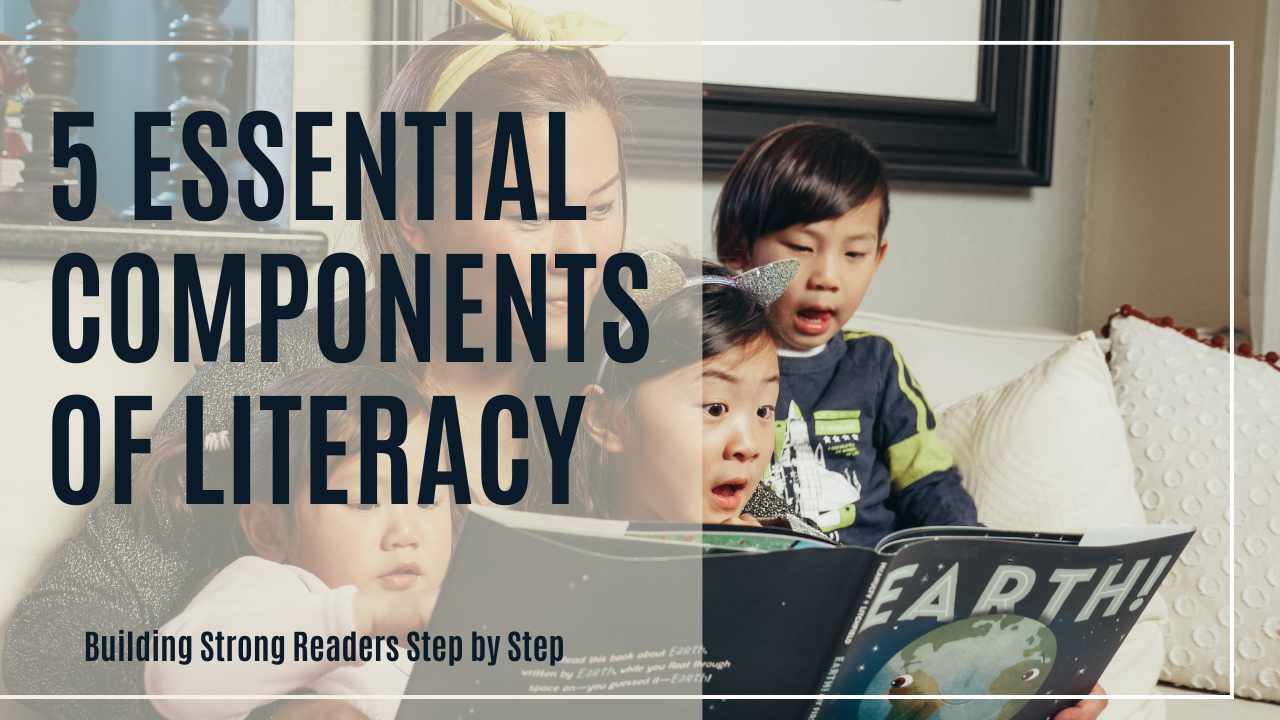
The 5 Essential Components of Literacy: Building Strong Readers Step by Step
Literacy is more than just reading words on a page—it’s the foundation for all learning. When children master literacy skills, they open the door to academic success and lifelong confidence. Research from the National Reading Panel highlights five essential components of effective reading instruction, often called the “Big Five.” Understanding these components can help parents support their children’s literacy journey at home and recognize high-quality reading instruction in schools or intervention programs.
1. Phonemic Awareness
What it is: The ability to hear, identify, and manipulate individual sounds (phonemes) in spoken words.
Why it matters: Phonemic awareness is the foundation of reading. Before kids can sound out words, they must understand that words are made up of sounds. For example, recognizing that the word cat has three sounds: /k/ /a/ /t/.
How to support it at home:
- Play rhyming games or sing nursery rhymes.
- Practice sound deletion (e.g., “What’s stop without the /s/?”).
- Clap out the number of sounds in simple words.
2. Phonics
What it is: The relationship between letters and sounds—knowing how written letters (graphemes) match spoken sounds (phonemes).
Why it matters: Phonics helps children decode (sound out) words while reading and encode (spell) words while writing. It connects spoken language to written language.
How to support it at home:
- Help your child sound out unfamiliar words while reading.
- Use letter magnets to build simple words and change beginning or ending sounds.
- Encourage writing and spelling during everyday activities, like making grocery lists or writing cards.
3. Fluency
What it is: The ability to read accurately, quickly, and with expression.
Why it matters: Fluent readers don’t need to focus so hard on decoding words, which allows them to focus on understanding what they read.
How to support it at home:
- Read aloud to your child with expression and rhythm.
- Encourage your child to reread favorite books.
- Try “echo reading,” where you read a sentence and your child repeats it.
4. Vocabulary
What it is: The body of words a child understands and can use correctly in conversation, reading, and writing.
Why it matters: A strong vocabulary improves reading comprehension. If a child doesn’t understand the meaning of words, it’s difficult to make sense of what they’re reading.
How to support it at home:
- Read a variety of books together and pause to talk about interesting or unfamiliar words.
- Use rich language in daily conversations.
- Play word games like “Categories” or “I Spy” with descriptive clues.
5. Comprehension
What it is: The ability to understand, remember, and make sense of what is read.
Why it matters: Comprehension is the goal of reading. Even if a child can decode words, they must also be able to understand and interpret meaning.
How to support it at home:
- Ask open-ended questions after reading, such as “Why do you think the character did that?”
- Encourage your child to summarize stories in their own words.
- Make connections between books and real-life experiences.
Putting It All Together
Each of these five components is critical—and they work together. For example, a child who is fluent but struggles with vocabulary may not fully understand what they read. Similarly, strong phonics skills without phonemic awareness can lead to difficulties in decoding unfamiliar words.
You may also like
Use Schema to Boost Reading Comprehension
Fluent Reading: What is It and Why is It Important?