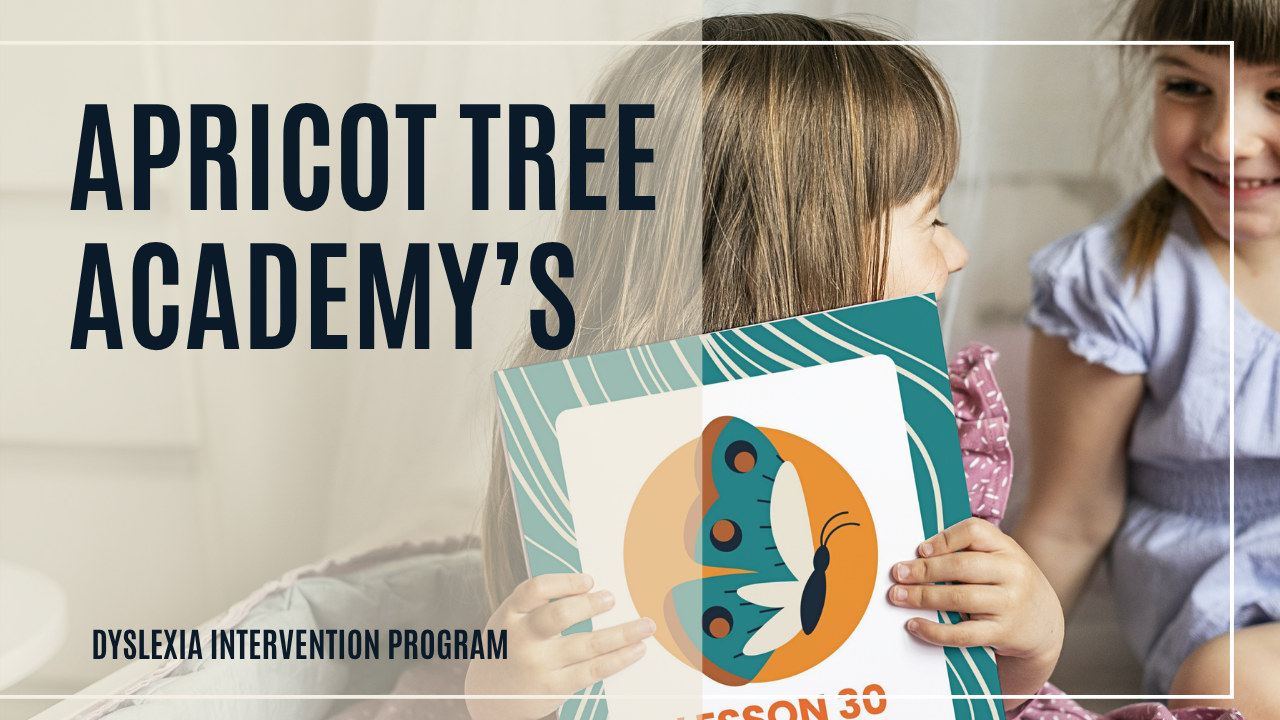
Apricot Tree Academy’s Dyslexia Intervention Program is a complete, parent-friendly reading curriculum that uses the Orton-Gillingham approach to teach children with dyslexia to read, write, and spell. It pairs a scripted teacher’s guide with a student workbook, organizing instruction into weekly lessons you can run at the kitchen table. You can explore the full Dyslexia Intervention Curriculum or pick up the workbook on Amazon to get started.
What is the Dyslexia Intervention Program?
The Dyslexia Intervention Program is a comprehensive, at-home reading curriculum built specifically for children with dyslexia. It is a structured-literacy program that teaches reading explicitly and systematically, in the sequence a dyslexic brain needs. Rather than expecting a child to absorb reading through exposure, it breaks the code of English into small, teachable steps and practices each one until it sticks.
The program comes in two parts that work together:
- The teacher’s guide — scripted, step-by-step lesson plans that tell you exactly what to say and do, so you don’t need prior training to teach it.
- The student workbook — the matching practice pages your child works through during each lesson.
Because it’s designed for parents, the program assumes no background in special education. If you’re weighing options, our guide to the best dyslexia curriculum for parents walks through what to look for when you have no teaching experience.

Why does the Orton-Gillingham approach work?
The program is grounded in the Orton-Gillingham approach, the method most widely recognized for helping children with dyslexia learn to read. Orton-Gillingham is a structured, multisensory way of teaching reading that engages sight, sound, and touch at the same time. When a child sees a letter, says its sound, and traces its shape together, more pathways in the brain fire at once—and that is exactly what a dyslexic reader needs to build durable connections between letters and sounds.
Three features of the approach matter most for children with dyslexia:
- Explicit — nothing is left for the child to guess. Each sound, rule, and pattern is taught directly.
- Systematic and cumulative — skills are introduced in a logical order, and each new lesson builds on what came before, so gaps don’t pile up.
- Diagnostic — you watch what your child has mastered and what they haven’t, and you reteach before moving on rather than pushing ahead and hoping.
This approach lines up with the broader body of research known as the Science of Reading, which shows that explicit, systematic phonics instruction is what struggling readers respond to. Apricot Tree Academy’s program puts those principles into a format an ordinary parent can actually deliver, week after week.
How are the weekly lessons structured?
Each week is a single, self-contained lesson plan designed to run about 50–60 minutes. The lessons are built to be efficient and genuinely enjoyable, so your child stays engaged rather than worn down. Every section has a clear purpose and moves your child forward while keeping a healthy balance between challenge and confidence.
A typical lesson cycles through the core skills of structured literacy:
- Phonemic awareness — hearing and manipulating the individual sounds in words.
- Phonics — connecting those sounds to the letters that spell them.
- Reading practice — applying the new pattern to real words and sentences.
- Spelling and writing — reinforcing the same patterns from the other direction.
The scripted format means you open the guide, follow the steps, and teach—there’s no lesson-planning homework for you at the end of a long day. Because the same skills come back week after week in slightly harder form, your child gets the repetition dyslexic readers depend on without the lessons ever feeling stale. By the end of a session your child has read, spelled, and written using the very same pattern, which is what locks it into long-term memory.
How do I adapt the program to my child’s pace?
You are in charge of the pace, and the program is designed to flex around your child. If a week moves too fast or feels overwhelming, you have permission to slow down. You will not fall behind by giving your child the time they need—mastery matters far more than speed.
Two simple ways to ease the load:
- Trim the activities. On a tough day, it’s perfectly fine to stop before finishing every word or sentence in a section. Getting through the lesson calmly beats grinding to the last item.
- Stretch a week across two. Cut each activity in half and take two weeks to complete one lesson. This gives your child room to truly master a concept without pressure.
Protecting your child’s well-being and keeping reading time positive is the priority. Celebrate every milestone, no matter how small—each one is real evidence of growth. Keeping the experience encouraging also protects your child’s self-esteem and confidence, which struggling readers need just as much as the phonics.
What support do parents get?
One of the hardest parts of a dyslexia diagnosis is the feeling that you have to figure it all out by yourself. You don’t. The program is built around the idea that you are not alone—Apricot Tree Academy stands beside you as an ally, offering guidance and resources so you can teach with confidence instead of guesswork.
That support shows up in a few practical ways:
- Scripted lessons remove the pressure of designing instruction yourself, so your energy goes into your child rather than into planning.
- A clear, sequenced path means you always know what comes next and why, which keeps the work from feeling random or improvised.
- An open line to our team for the questions and concerns that come up along the way—we’re here to collaborate, not just hand you a book.
Your involvement is the most powerful ingredient in your child’s progress, and encouragement and patience carry that involvement a long way. Dyslexia comes with real strengths—creativity, big-picture thinking, problem-solving—and a program that keeps reading positive lets those strengths grow alongside the reading skills. The goal isn’t just to get your child reading; it’s to help them see themselves as capable.
How do I get started?
Getting started is straightforward. Read through the program overview, gather the two components, and schedule your first weekly lesson:
- Review the full Dyslexia Intervention Curriculum to see how the program is organized.
- Get the workbook on Amazon along with the matching teacher’s guide.
- Block out one 50–60 minute session per week, in a quiet spot, at a time of day when your child has energy.
You don’t have to do this alone. Our team is available to answer questions, and we’re here to collaborate with you throughout the process so you can build a calm, encouraging learning environment where your child can flourish.
Frequently Asked Questions
Do I need teaching experience to use the program?
No. The teacher's guide is fully scripted, so it tells you what to say and do at each step. It was written for parents with no background in special education or teaching.
How long does each lesson take?
Each weekly lesson is designed to run about 50 to 60 minutes. On busy or hard days you can trim the activities or split a single lesson across two weeks.
What approach does the program use?
It uses the Orton-Gillingham approach, a structured, multisensory method that's widely recognized as effective for children with dyslexia. It aligns with the Science of Reading and structured literacy.
What ages is the program for?
It's built for children ages 5 to 10 who are learning to read or struggling with reading. The pace is adjustable, so you can match it to your child's individual needs.
What's included in the program?
The program includes a scripted teacher's guide with weekly lesson plans and a matching student workbook for practice. Together they cover phonemic awareness, phonics, reading, and spelling.